
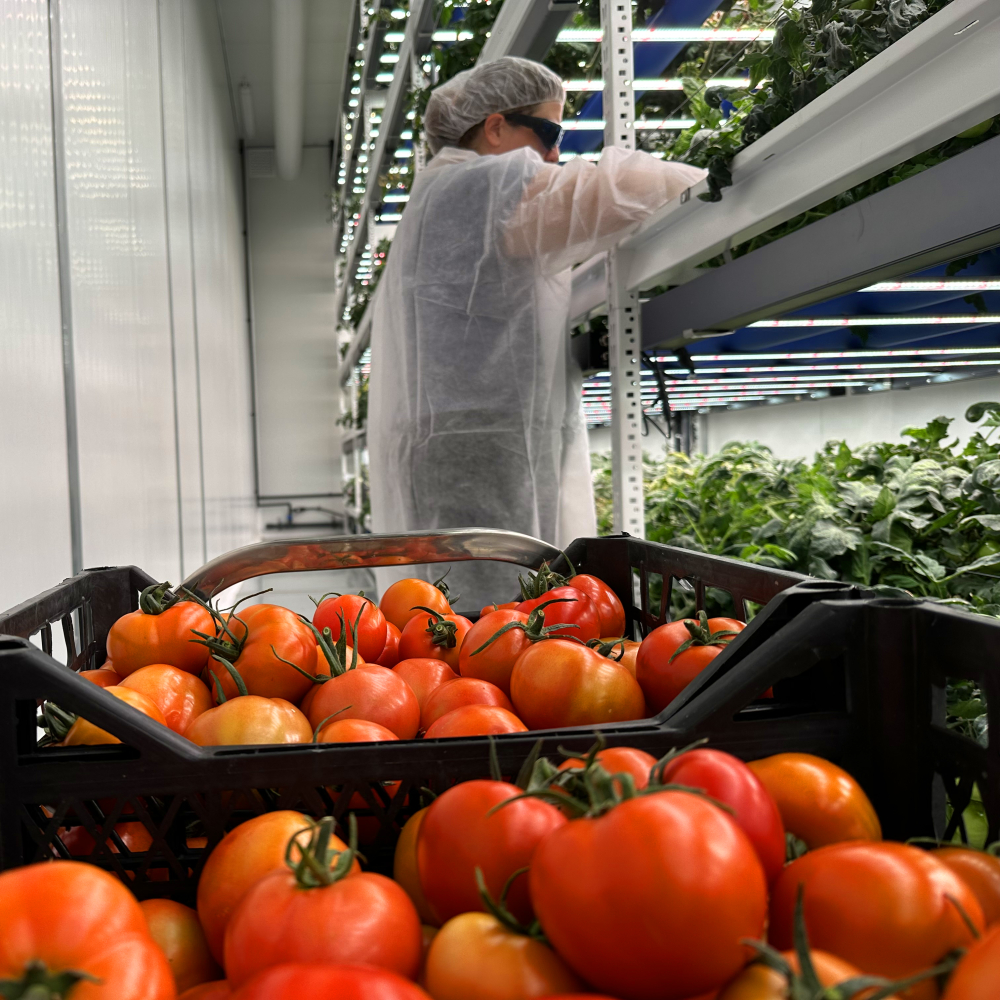
How AI Agents Could Grow Tomatoes: The Future of AI in Agriculture
What if an AI system could do more than analyze agricultural data?
What if it could monitor a tomato plant, understand what the plant needs, make decisions, and control the environment around it?
This is the direction in which AI in agriculture is heading.
The combination of Artificial Intelligence (AI), Internet of Things (IoT), computer vision, sensors, and automation is creating new possibilities for smart farming and precision agriculture. Research into smart greenhouse systems has already demonstrated the ability to monitor tomato-growing environments in real time and use AI to identify tomato ripeness.
The next step is moving from systems that monitor and recommend to AI agents that can observe, reason, and act.
What Is an AI Agent in Agriculture?
An AI agent is a system designed to perceive its environment, process information, make decisions, and take actions toward a specific objective.
In agriculture, that objective could be simple:
Grow healthy tomatoes while using water, energy, and other resources efficiently.
Instead of relying on a farmer to manually check every condition, an AI-powered agricultural system could continuously monitor the environment and respond when conditions change.
This could create a cycle:
Sense → Analyze → Decide → Act → Learn
That is where AI agents could become particularly valuable in farming.
How AI Can Monitor a Tomato Farm
Growing tomatoes requires managing several environmental conditions.
Smart agriculture systems can use sensors to continuously monitor:
-
Soil moisture
-
Temperature
-
Humidity
-
Light intensity
-
Crop condition
The research behind modern smart tomato greenhouse systems shows how these sensors can provide real-time information about the growing environment. Soil moisture sensors, for example, can help determine when irrigation is required, while temperature and humidity sensors help monitor conditions that affect plant growth and disease risk.
This creates something traditional farming has never had at this scale:
a continuous stream of data from the farm.
AI Gives the Greenhouse Eyes
Sensors provide numbers.
Cameras provide something different: visual information.
Computer vision can allow an AI system to inspect plants and fruit through images.
In the smart tomato farming system described in the research, a Raspberry Pi camera is combined with a YOLOv8 deep-learning model to identify different tomato ripeness stages, including green, near-ripe, and fully ripe tomatoes.
This means AI can potentially help answer questions such as:
Which tomatoes are ready to harvest?
Which fruits are still developing?
Are there visible signs of disease or stress?
Computer vision therefore becomes another layer of intelligence in the agricultural system.
From Data to Decisions
Collecting information is only the beginning.
The real value of AI comes from transforming that information into useful decisions.
For example, imagine an AI agent monitoring a greenhouse.
It notices that:
-
Soil moisture is decreasing.
-
Temperature is increasing.
-
Humidity is changing.
-
The weather forecast indicates a hotter period.
Instead of simply displaying these numbers, an intelligent system could analyze the situation and determine whether the plants may require additional irrigation or ventilation.
Research into precision agriculture shows how data analysis and machine learning can identify patterns, predict crop conditions, and support proactive interventions.
This is the difference between data collection and intelligent decision-making.
The Next Step: Autonomous Agriculture
Automation takes the idea one step further.
Smart agriculture systems can already support automated management of resources such as irrigation, ventilation, and lighting based on environmental data.
Imagine connecting these capabilities to an AI agent.
The agent could:
-
Monitor the greenhouse using sensors and cameras.
-
Analyze environmental and visual data.
-
Identify potential problems.
-
Decide what action may be appropriate.
-
Control irrigation, ventilation, or lighting.
-
Monitor the outcome.
-
Improve future decisions using historical data.
The research identifies automated irrigation and ventilation, alongside technologies such as Edge TPU and LoRa, as future directions toward a more fully autonomous smart greenhouse.
Why AI-Powered Agriculture Matters
The importance of this technology extends beyond tomatoes.
Agriculture faces increasing pressure from population growth, limited resources, labor challenges, and changing environmental conditions. Precision agriculture combines technologies such as IoT, wireless sensor networks, AI, and data analytics to improve how crops are monitored and managed.
AI-powered farming could help farmers:
-
Use water more efficiently
-
Detect problems earlier
-
Improve crop monitoring
-
Optimize greenhouse conditions
-
Plan harvests more effectively
-
Reduce resource waste
-
Improve crop productivity
The goal isn't simply to make farming more technological.
The goal is to make farming more informed, efficient, and sustainable.
The Future of Smart Farming
The future of agriculture may not be about replacing farmers with machines.
It may be about giving farmers intelligent systems that can continuously observe what is happening on the farm and help them make better decisions.
AI agents could become another layer between data and action.
Sensors understand the environment.
Cameras understand the crops.
AI understands the data.
Automation takes action.
And farmers remain at the center of the system, using technology to manage agriculture more intelligently.
As research and technology continue to advance, smart greenhouses could become increasingly connected, automated, and capable of responding to changing conditions in real time.
From AI That Answers to AI That Acts
We often think about AI as something that answers questions.
But the next generation of AI is moving toward something more powerful:
AI that can pursue goals.
And agriculture is one of the most interesting environments in which to explore that possibility.
Because ultimately, an AI system doesn't just need to tell us how to grow a tomato.
The real challenge is:
Can it help us actually grow one?
At Vintage Technologies, we believe the future of technology is not only about building smarter software. It is about using technology to solve real-world problems and create systems that can make a measurable difference.
From digital platforms to emerging technologies, the opportunity is enormous.
And perhaps, in the future, one of the clearest demonstrations of AI's ability to interact with the physical world will be something remarkably simple:
a tomato growing in a smart greenhouse. 🍅🤖


Comments
No comments yet. Be the first to comment!