
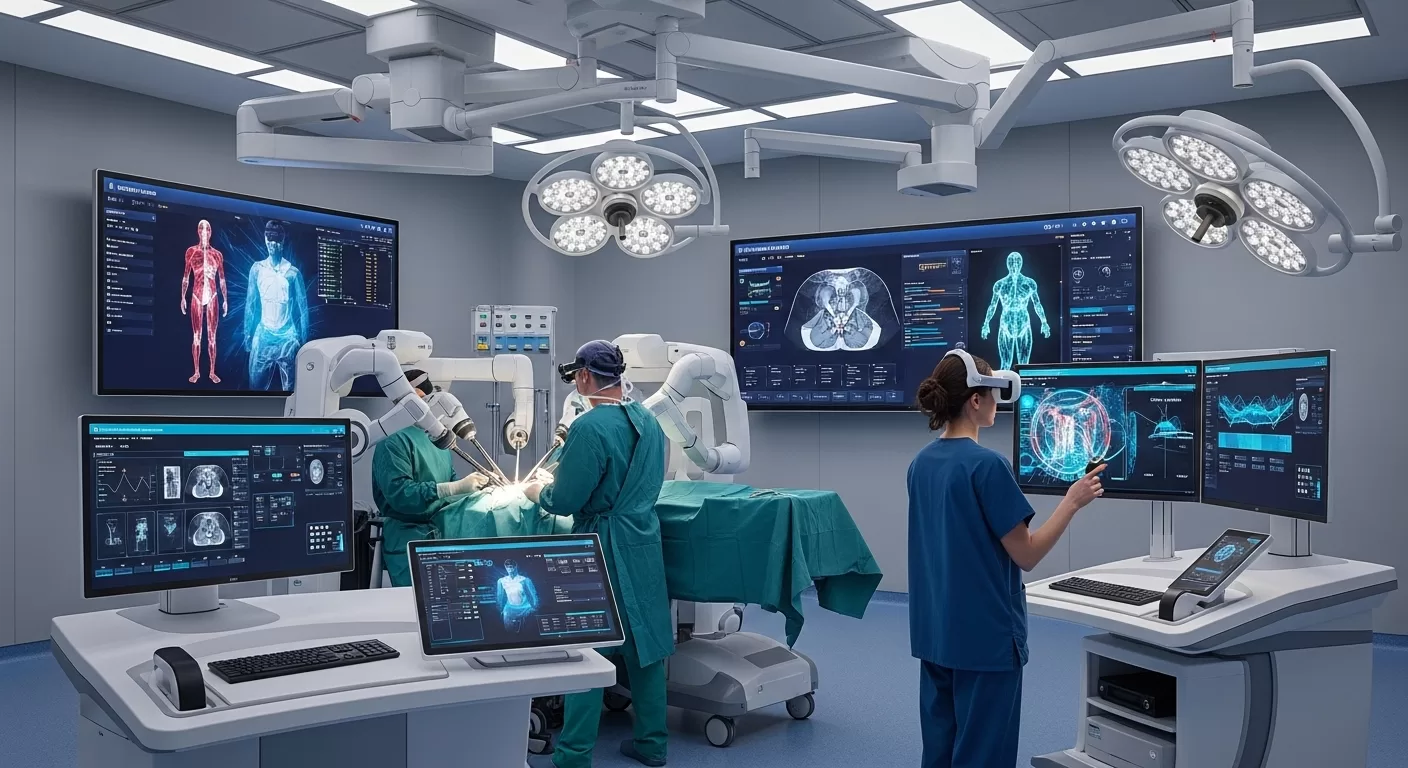
Healthcare is entering a new technological era.
Artificial intelligence (AI) and robotics are no longer concepts limited to research laboratories or science fiction. They are increasingly being integrated into real clinical environments, helping healthcare professionals improve precision, efficiency, patient monitoring, rehabilitation, and hospital operations.
The convergence of AI and medical robotics is particularly significant because it is changing the role of robots. Instead of functioning only as machines controlled by humans, next-generation medical robots are increasingly being developed to perceive their environment, process information, support decision-making, and adapt to changing situations.
For technology companies such as Vintage Technologies, this transformation represents more than a technological trend. It demonstrates how intelligent digital systems can reshape some of the world's most complex industries.
From Robotic Tools to Intelligent Healthcare Partners
Early medical robots primarily focused on extending human capabilities. Surgical robotic systems, for example, allowed physicians to control robotic instruments with greater precision and enhanced visualization.
Today's systems are moving toward something more sophisticated.
Powered by technologies such as machine learning, computer vision, deep reinforcement learning, natural language processing, large language models (LLMs), and digital twins, medical robots can increasingly understand their surroundings and support complex clinical workflows.
Research describes this transformation as a shift from teleoperated tools toward intelligent partners capable of perception, reasoning, and adaptation.
This shift could fundamentally change how healthcare is delivered.
The AI Technologies Powering Medical Robotics
The future of medical robotics is not driven by a single technology. Instead, several AI capabilities work together to give robots increasingly sophisticated abilities.
1. Computer Vision: Helping Robots Understand Their Environment
For a medical robot to operate safely, it must first understand what is happening around it.
Computer vision allows AI systems to analyze visual information from cameras and medical imaging. In surgical environments, this can help robots recognize anatomical structures, track surgical instruments, identify tissues, and construct three-dimensional representations of the operating environment.
This moves robotics from simply seeing an image to actually interpreting what is happening within that image.
AI-powered perception can also extend beyond the surgical field. Future systems may need to understand the position of patients, medical staff, equipment, instruments, and other objects within the clinical environment.
This broader situational awareness is an important foundation for safer robotic autonomy.
2. Deep Reinforcement Learning: Teaching Robots How to Act
Seeing is only one part of intelligence. A robot must also determine what action to take.
Deep reinforcement learning (DRL) provides a way for robots to learn complex decision-making and control strategies.
In medical robotics, researchers are exploring DRL for tasks such as surgical suturing, tissue manipulation, path planning, and robotic needle navigation.
The technology is particularly valuable in dynamic environments where conditions can change continuously. Rather than following only a fixed sequence of programmed instructions, an AI system can learn how different actions affect outcomes and adapt its behavior.
This could eventually enable robots to perform increasingly complex tasks while remaining under appropriate human supervision.
3. Large Language Models Are Changing Human-Robot Interaction
One of the most exciting developments is the integration of large language models (LLMs) into medical robotics.
Traditionally, interacting with robots has required specialized interfaces, controllers, or predefined commands.
Natural-language interfaces could make this interaction much more intuitive.
A healthcare professional could potentially communicate with a robotic system using voice commands, while an AI system processes clinical information and provides relevant summaries.
LLMs may also support administrative and postoperative workflows by helping organize information and generate structured documentation.
However, healthcare applications require strong safeguards. Medical AI must be designed around reliability, privacy, security, and patient safety rather than convenience alone.
4. Digital Twins Could Change Surgical Planning
Another important development is the combination of AI and digital twin technology.
A digital twin can represent a patient-specific virtual model based on medical imaging and other clinical information.
Before a procedure takes place, physicians can potentially use this virtual environment to explore different approaches, simulate procedures, and evaluate possible outcomes.
This creates an opportunity to move some of the complexity of medical decision-making into a controlled digital environment before applying it in the physical world.
The same virtual environments can also support the development and training of robotic systems.
In this sense, digital twins could become an important bridge between simulation, AI, robotics, and personalized medicine.
Where AI-Powered Medical Robots Are Making an Impact
AI and robotics are not limited to surgery. Their applications extend across multiple areas of healthcare.
Intelligent Surgical Robotics
Robotic surgery has already demonstrated how technology can enhance precision and visualization.
The next stage is the development of systems capable of supporting increasingly autonomous tasks.
AI-powered surgical robotics can combine computer vision, sensor information, robotic control, and medical imaging to assist physicians during procedures.
The long-term vision is not necessarily to remove humans from the operating room. Instead, it is to create human-machine collaboration, where robots handle certain precise or repetitive tasks while clinicians remain responsible for high-level decisions.
Rehabilitation Robotics
AI is also changing rehabilitation.
Rehabilitation robots can support patients recovering from physical or neurological impairments through individualized training programs.
These systems can assist with both large movements and fine motor skills, including walking, limb movement, grasping, and hand coordination.
The integration of virtual reality (VR), brain-computer interfaces (BCI), sensors, and machine learning creates opportunities for more interactive and personalized rehabilitation.
Instead of relying entirely on standardized exercises, intelligent systems can potentially adapt rehabilitation activities based on a patient's performance and progress.
AI for Patient Monitoring
Robotics can also support continuous monitoring.
AI-powered systems can collect information through sensors and help monitor factors such as movement, vital signs, and patient activity.
Some robotic systems are being developed for environments ranging from hospitals to home care.
This could be particularly valuable in situations where healthcare professionals need additional support monitoring patients or identifying potential risks.
Robots for Hospital Operations
Some of the most practical applications of medical robotics happen outside the operating room.
Hospitals involve complex logistics. Medicines, equipment, specimens, records, and other materials must constantly move between locations.
Autonomous logistics robots can help transport materials while navigating hospital environments and avoiding obstacles.
Other robotic systems are being used or developed for:
-
Hospital disinfection
-
Patient transportation
-
Medication delivery
-
Facility navigation
-
Patient guidance
-
Triage support
-
Monitoring and surveillance
These applications demonstrate an important principle: healthcare robotics is not only about treating patients; it is also about improving the systems that support patient care.
Research identifies surveillance, disinfection, logistics, and triage as important areas where AI-driven robotics can improve hospital workflow and operational efficiency.
The Challenges Behind Intelligent Medical Robotics
Despite the enormous potential, AI-powered medical robotics is not without challenges.
Healthcare is a high-stakes environment, meaning technological innovation must be accompanied by rigorous testing, safety measures, and responsible implementation.
Data Quality and Availability
AI systems depend heavily on data.
Medical datasets can be difficult to collect and annotate because of privacy requirements, data quality issues, cost, and differences between patient populations.
A model that performs well in one environment may not necessarily perform equally well in another.
This makes model generalization an important challenge for medical AI.
Safety and Reliability
AI systems can sometimes behave unpredictably, particularly when they encounter situations that differ from their training data.
This becomes especially important when AI is integrated with physical robots.
A software error in a conventional application may be inconvenient. An unexpected action by a medical robot could have much more serious consequences.
Researchers therefore emphasize the importance of robustness, transparency, explainability, and rigorous validation for AI-driven medical robotics.
Privacy and Security
Medical robots can process extremely sensitive information.
Patient records, medical images, biometric information, and real-time monitoring data must be protected.
As healthcare becomes increasingly connected, cybersecurity and responsible data governance will become essential components of medical robotics.
Ethical and Legal Responsibility
Perhaps one of the most difficult questions is accountability.
If an autonomous or semi-autonomous medical system makes an error, who is responsible?
The physician? The hospital? The robot manufacturer? The software developer?
AI-driven medicine creates a complex chain of responsibility involving clinicians, patients, manufacturers, developers, and infrastructure providers.
Clear legal and ethical frameworks will therefore need to evolve alongside the technology.
The Future: From Automation to Collaboration
The future of medical robotics is unlikely to be about robots simply replacing healthcare professionals.
Instead, the more promising direction is collaboration.
Imagine a healthcare environment where:
-
AI analyzes medical information.
-
Computer vision helps robots understand their surroundings.
-
Digital twins simulate procedures before they happen.
-
Robots perform precise and repetitive tasks.
-
Rehabilitation systems adapt to individual patients.
-
Natural-language interfaces allow clinicians to communicate with machines.
-
Hospital robots automate logistics and routine operations.
-
Healthcare professionals remain at the center of critical decisions.
This represents a transition from automation to intelligent collaboration.
The research behind today's medical robotics points toward a future in which AI enables robots to perceive, reason, and adapt while supporting clinicians across surgery, rehabilitation, diagnostics, and healthcare services.
What This Means for the Future of Technology
The evolution of AI and medical robotics provides a broader lesson for technology companies.
Innovation is no longer simply about building software or machines that perform predefined tasks.
The next generation of technology will increasingly be about creating systems that can understand context, learn from information, interact naturally with people, and make intelligent decisions within clearly defined boundaries.
At Vintage Technologies, we believe technology should solve real problems and create meaningful impact.
The convergence of artificial intelligence, robotics, automation, and digital systems demonstrates what becomes possible when technology is designed not only to automate work, but to augment human capability.
As healthcare continues to evolve, intelligent robotics could become one of the defining technologies shaping the future of medicine.
And the journey has only just begun.


Comments
No comments yet. Be the first to comment!