
This future is becoming a reality.
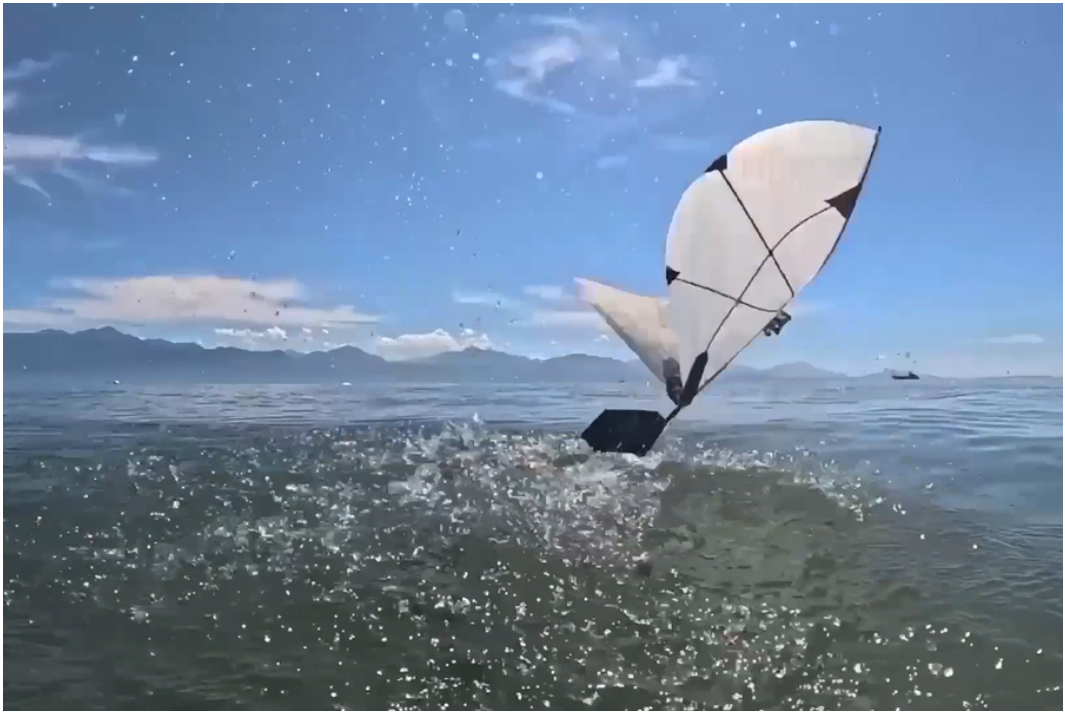
Engineers from the Massachusetts Institute of Technology (MIT) and the École Polytechnique Fédérale de Lausanne (EPFL) have developed a flapping-wing aerial-aquatic robot inspired by diving birds such as puffins, loons, and petrels.
The innovative robot can move between air and water, opening new possibilities for ocean exploration, environmental monitoring, and marine research.
What Is MIT’s Aerial-Aquatic Robot?
The robot, known as the Flapping-Wing Aerial-Aquatic Vehicle (FAAV), is a lightweight robotic system designed to operate in two challenging environments: air and water.
Unlike traditional drones that only fly or underwater vehicles that only swim, this robot combines both abilities.
Weighing less than 300 grams, the robot features:
- A lightweight central body containing a battery and waterproof motor
- Flexible wings that flap like a bird’s wings
- A controllable tail for movement and stability
- Adaptable wing designs for different environments
This design allows the robot to imitate the movement strategies used by diving birds.
How Does a Robot Fly and Swim?
One of the biggest challenges in building an aerial-aquatic robot is the difference between air and water.
Water is approximately 1,000 times denser than air, meaning a robot must use completely different mechanics to move effectively underwater.
MIT researchers solved this challenge by studying how birds adapt their wing movements.
Diving birds naturally adjust their flapping patterns:
- Faster wing movements help them fly through air
- Slower, stronger movements allow them to swim underwater
By copying these principles, engineers created a robot capable of transitioning between both environments.
Inspired by Birds: The Science Behind the Design
Nature has already created highly efficient systems for movement.
Birds like puffins can dive into water, swim after prey, and return to flight within moments. Researchers studied these birds to understand how their bodies handle the transition between air and water.
The MIT team analyzed:
- Wing flexibility
- Flapping frequency
- Body position
- Tail movement
They discovered that flexible wings are essential because they must be soft enough to move through water but strong enough to generate lift during flight.
Testing the Robot’s Flight and Underwater Abilities
Researchers tested the robot in controlled water tanks and later in Lake Geneva, Switzerland.
The experiments showed that the robot could successfully:
* Swim underwater
* Move toward the surface
* Break through the water
* Fly away after emerging
The robot reached underwater speeds of nearly 1 meter per second and air speeds of around 6 meters per second.
Scientists also discovered that the robot could launch from water without using feet or a paddling mechanism.
This is different from many diving birds, which rely on their feet to help push themselves into flight.
How This Technology Could Change Ocean Exploration
The development of aerial-aquatic robots could transform the way scientists study oceans.
Traditional ocean research often requires expensive ships, large equipment, and significant resources. Small autonomous robots could provide a faster and more affordable alternative.
Future applications may include:
1. Marine Research
Scientists could use these robots to collect water samples, study marine life, and monitor changes in ocean ecosystems.
2. Climate and Environmental Monitoring
The robots could gather data from difficult locations such as:
- Icebergs
- Remote coastal areas
- Deep-water environments
3. Wildlife Observation
Aerial-aquatic robots could help researchers study whales, seabirds, and other marine species with minimal disturbance.
4. Coastal Infrastructure Inspection
Ports, offshore facilities, and coastal structures could be monitored using autonomous robotic systems.
The Future of Bio-Inspired Robotics
MIT’s flying and swimming robot represents a growing trend in technology: bio-inspired robotics.
Instead of designing machines from scratch, engineers are studying nature’s solutions and adapting them for human challenges.
From robotic insects to underwater drones, nature continues to inspire the next generation of technology.
As researchers improve this robot’s ability to handle strong winds, waves, and changing environments, it could become an important tool for ocean scientists around the world.
A New Era of Exploration
The development of MIT’s aerial-aquatic robot shows how science and nature can work together to solve complex problems.
A machine that can fly like a bird and swim like a marine animal may once have seemed impossible. Today, it represents a glimpse into the future of exploration.
The next generation of ocean discovery may not only depend on ships and submarines.
It may come from small intelligent robots that move freely between the sky and the sea.
Why Innovations Like This Matter for Vintage Technologies
At Vintage Technologies, we believe the future of technology is built around solving real-world problems through innovation.
The development of MIT’s aerial-aquatic robot reflects several technology trends shaping the future:
1. Intelligent Autonomous Systems
The future belongs to machines that can sense, adapt, and make decisions independently.
Similar technologies can support industries such as:
- Transportation
- Logistics
- Agriculture
- Environmental monitoring
- Smart infrastructure
2. Smart Mobility Beyond Traditional Transportation
Mobility is no longer limited to roads.
The next generation of mobility solutions will combine:
- Air movement
- Land transportation
- Marine exploration
- Autonomous navigation
This vision aligns with the global shift toward smarter, connected transportation ecosystems.
3. Technology Inspired by Nature
Nature has spent millions of years optimizing movement, efficiency, and adaptation.
Bio-inspired engineering allows innovators to create solutions that are:
- More efficient
- More sustainable
- Better adapted to complex environments
4. African Innovation Opportunities
Emerging technologies like robotics and autonomous systems create opportunities for African innovators to solve local challenges.
From agriculture and logistics to environmental protection and public services, intelligent technology can help build more efficient systems for communities.
At Vintage Technologies, our focus is creating digital solutions that improve everyday life — from mobility and employment technology to enterprise systems and innovative platforms.



Comments
No comments yet. Be the first to comment!